An infographic of Sadar Hati's achievements spanning a 24-year journey (2002–2026) — not just statistics, but a story about the epidemic context, operational scale, and real impact. Historical data from the HCPI era 2010-2014 + current ViiV-era data across the ASEAN region.
24 Years of Sadar Hati in Numbers
Years in Operation
24
2002 — 2026 · Established 1 February 2002
Donor Track Record
7
FHI ASA · GF R4 · HCPI · GF R8 · SUM · BNN · ViiV
Peak Region
6+
Jawa Timur Regencies/Cities 2012
Total Eras
5
Founding · ASA · HCPI Peak · Transition · ViiV
Why Harm Reduction · Kota Malang Epidemic Context
This context answers the donor's question: "Why does this area need Harm Reduction intervention?" — with evidence-based data, not claims.
PWID HIV Prevalence — Kota Malang vs National Average
National AverageSTBP 2011 · Integrated Biological and Behavioral Survey
36,4%
Kota Malang LocalSurvey YSH+SUM May-Jun 2012 · 200 PWID sample
42,31%
+5.9 percentage points above the national average — explaining why Kota Malang was identified as the #2 concentrated HIV/AIDS area after Surabaya in Jawa Timur (YSH Profile · Theo Zaenuri, July 2012). Plus 1,875 cumulative HIV cases Dinkes Kota Malang as of June 2012. The urgency of the Harm Reduction program = evidence-based, not assumption.
Operational Scale of the HCPI Era · Peak Years 2011-2012
PWID Coverage Rate
75%
800 PWID reached out of an estimated population of 1,070
Sadar Hati reaches 3 of 4 people who inject drugs in Kota Malang in late 2011 — the result of intensive mapping of 50 hotspots + a layered outreach team.
Multi-donor matrix (HCPI · GF Round 8 · SUM · BNN) enables a coverage rate that a single donor could not achieve.
Source: KPA Kota Malang + Sadar Hati 2011 Mapping (combined dataset) · HCPI 2012 Final Report
LJSS Return Rate — Best-Practice Indicator
The needle-and-syringe return rate = a key quality indicator for the Harm Reduction program. High = sustainability + safe disposal + trust from people who inject drugs.
National TargetIndonesia's minimum harm-reduction standard
↗ Sadar Hati exceeds national best-practice 40% benchmark by ~19 percentage points — and still improving (55,2% → 59,2% in 6 months). A sustainability marker for donors: the program is not only surviving, but maturing.
LJSS Distribution Trend · Operational Consistency Jan-July 2012
4.690
Jan
55,2%
Feb
Mar
Apr
5.336 ⭐
May
55,3%
Jun
5.246
Jul
59,2%
+13.8% growth Jan→May · consistency 5,000+ needles/month throughout H1 2012 · 261-276 active LASS PWID as monthly recurring beneficiaries · Quality matures: return rate 55.2% → 59.2%.
Geographic Footprint of the HCPI Era · 6+ Regencies/Cities in Jawa Timur
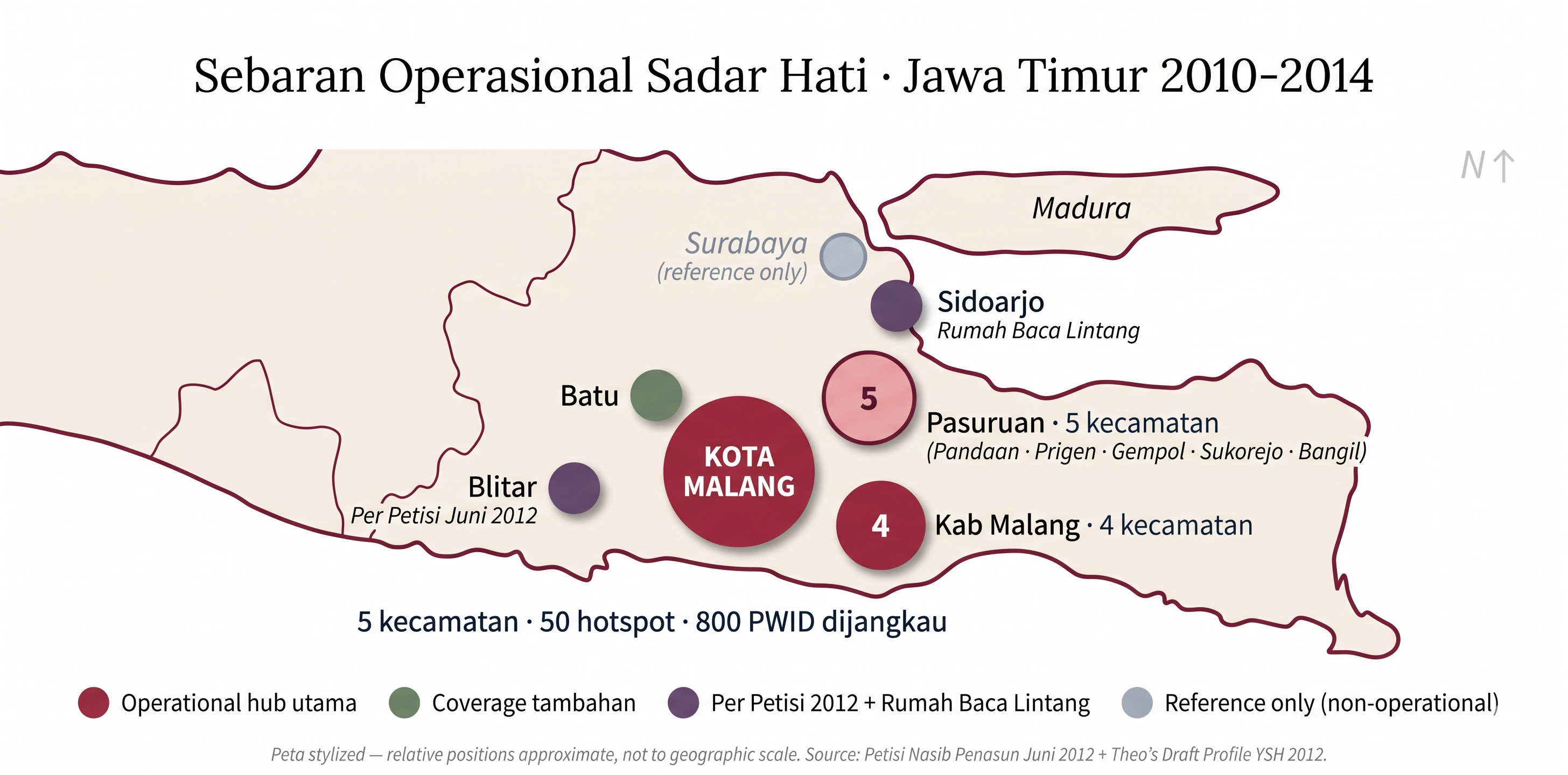
Sadar Hati is not a single-city Malang NGO — geographic coverage 5 main areas + 2 additional areas in Jawa Timur. Per the Petition on the Fate of Injecting Drug Users, June 2012, plus Sidoarjo (Rumah Baca Lintang, Ms. Watiek).
Sadar Hati Operational Distribution · HCPI Era 2010-2014
BatuPer the Petition on the Fate of Injecting Drug Users, June 2012
🟣 EXTENDED COVERAGE
BlitarPer the Petition on the Fate of Injecting Drug Users, June 2012
🟣 CHILDREN'S LITERACY
SidoarjoRumah Baca Lintang · Mba Watiek's literacy project
⚪ REFERENCE ONLY
Surabaya#1 HIV-concentrated region in East Java · Sadar Hati NON-operational
GEOGRAPHIC REF
MaduraSeparate island · not covered operationally
Geographic insight for donors: Sadar Hati = 3 main hubs (Kota Malang + Kab Malang + Pasuruan) + 3 extended areas (Batu + Blitar + Sidoarjo). Coverage of 6+ regencies/cities in Jawa Timur within a single regional NGO = signal of capacity for multi-administrative coordination. Not a single-city NGO — already regional operator since the HCPI era.
Research-Grade Surveillance Infrastructure
PWID Surveillance · 7-Month Time-Series, Dec 2011 – Jun 2012
Total Sterile Needles Distributed
5.011
Dec 2011 – Jun 2012 · average 716 needles/month · peak 1.008 in May 2012
Used Needle Return Rate
58,6%
2,934 needles returned · best-practice harm reduction benchmark · peak 67% in May 2012
LJASS Trajectory · Needle Distribution vs Return
Needles Distributed Needles Returned
HCT Testing
431
HIV Testing & Counseling · peak 87 in May 2012 · average 62/month
IMS Services
266
Sexually transmitted infection screening + treatment · peak 54 in Jun 2012 · 38/month
HIV Awareness Reach
1.105
HIV education contacts · peak 258 in Dec 2011 · 158/month average
Operational Peak: May 2012
The system reached peak efficiency in May 2012 — 1,008 needles out + 670 returned = 66.5% return rate · 87 HCT · 51 IMS · 214 HIV awareness contacts. This pattern is no coincidence: the pre-Renstra (Strategic Plan) phase of Nov 2012 + 3 TA Provider engagements (Satunama · Penabulu · Surveymeter) were being on-boarded, and the M&E system and internal data system reached operational stability.
Puskesmas-Based Services · 8+ Active Partners 2012
Sadar Hati does not operate in a silo — it is embedded in the public health service system through 8+ Puskesmas + 3 PTRM + RSU Syaiful Anwar (GF ATM). This pattern is sustainable + scalable.
5 Puskesmas · Dinoyo IMS service · PTRM Kendalsari
Malang Regency
Gondanglegi · Tumpang · Sumber Pucung
Plus RS Kanjuruhan + PTRM Gondanglegi
Pasuruan
Bangil · Pandaan
Plus CST RSUD Bangil + PTRM Bangil (new 2012)
PTRM Network
Syaiful Anwar General Hospital, Malang
Supported by GF ATM since 2009 · 3 PTRM total
Capacity Building & Knowledge Archive
Knowledge archives are not merely legacy — they are the basis for Sadar Hati's future LMS (Learning Management System). Materials are organized, categorized, and retrievable. Future donors can audit them transparently.
Training Materials Archive
500+
527 curated files from the 2009-2014 era
18 integrated TB-HIV training modules (modules 1-48) + advocacy materials + IEC + epidemiology training + PO daily reporting protocols. All neatly archived.
Foundation for migration to a modern LMS: 2,622 activity photos categorized into 25+ event/program types, plus 9+ public mass events documented (HIV Fun Walk 2009, HAS 2009/2012, TB Day, MRAN 2008, etc).
Sadar Hati does not operate in a silo — embedded in 4-layer ecosystem: East Java peer NGOs, government, women's crisis services, and technical assistance providers. The network pattern = a sustainability marker.
Layer 1 · Peer NGO Jatim
4 harm reduction NGOs
Bina Hati Surabaya · Bambu Nusantara Madiun · EJA · Orbit — the HR Jatim peer network for cross-city coordination + knowledge exchange.
PPA · LP3A · Rifka Annisa (Yogyakarta) — protection of women partners of PWID + GBV-PWID integration.
Layer 4 · TA Providers 2012
3 Providers
SATUNAMA (institutional) · Penabulu (finance) · Surveymeter (monitoring and evaluation) — investment in organizational strengthening, Pre-Strategic Plan, Nov 2012.
Network insight for donors: 4-layer partnership × 17+ formal actors = an ecosystem that not easy to replicate by a new NGO. This is not starting from scratch — Sadar Hati brings institutional network capital that is immediately functional for future donors.
Coverage Map · Operational Hotspots Dec 2011 – Jun 2012
Total Distinct Hotspots
175
2,793 daily distribution activities at this hotspot
Active Operational Areas
6
Kota Malang + Kab Malang + Kota Batu + Pasuruan + Institutional venues · regional coverage
2 active subdistricts · Gempol 133 · Pandaan 28 · expansion outside the Malang area
MALANG REGENCY
71
2 subdistricts · Pakis 42 · Wagir 29 · coverage in the rural regency area
KOTA BATU
27
Activity recorded · confirms the June 2012 Petition claim regarding coverage of Kota Batu as an extended area
OTHER / UNCATEGORIZED
597
Top 10 Hotspots · Activity Density Distribution
Pattern Insight: 90% Mobile Community-Based
266 activities at institutional venues (DIC, RSSA, Puskesmas) vs 2,527 activities at community hotspots = ~90% mobile outreach. This is a signature classical Harm Reduction pattern — Sadar Hati is NOT a clinic-based service waiting for clients, but rather active community engagement where PWID naturally congregate.
Geographic concentration: the Jl. Semeru corridor (Klojen) = 627 activities = single biggest hotspot, confirming the peer-worker model with the ILOM (Indigenous Leaders Outreach Model) strategy that appears in the 2012 HCPI report.
Privacy & anonymization: Data displayed in sub-district/urban-village/street level only (NOT the full address or RT/RW). Historical hotspot 2011-2012 — part of the PWID community has since relocated or programs there have ended. For future donor dashboards, aggregation at the ward level at minimum = best-practice ethics. Per-location details are not shown to the public.
🇮🇩 National Context · STBP 2011 — Kota Malang in Indonesia's Surveillance
STBP 2011 (Integrated Biological & Behavioral Surveillance) — peer-reviewed national surveillance by the Ministry of Health of the Republic of Indonesia across 11 provinces · 8 high-risk groups. Kota Malang selected as 1 of 3 cities for PWID TLS sampling (Time-Location Sampling — together with DKI Jakarta & Medan City). Sadar Hati's work = part of the national-level evidence base.
Kota Malang in STBP 2011 · PWID
1 / 3
A PWID city in the national TLS sampling · together with Jakarta & Medan · national evidence-base context of Kemenkes RI
National PWID HIV Prevalence
36%
Highest of the 7 high-risk groups · tends to decline compared to STBP 2007 (Jakarta -10%, Medan -20%)
HIV Prevalence by Target Group · STBP 2011 Indonesia
PWID Needle Sharing 2004 → 2007 → 2011 · 6 Cities in Indonesia
DECLINING trend — longitudinal evidence that the national Harm Reduction program is succeeding. Kota Malang (wine highlighted) among the 6 cities tracked.
HIV-AIDS Knowledge
44%
PWID = HIGHEST of 8 groups. Indicator of an effective HR program. Trans women 32% · LSL 26% · High-risk men 14%
HIV Prevalence Trend
↓
PWID tend to DOWN national · Jakarta -10% · Medan -20% vs STBP 2007. Direct evidence of HR prevention.
Malang Needle Sharing
↓ 12%
Malang City 2011 — down from the pre-Sadar Hati era. Sadar Hati's contribution is measurable nationally.
Strategic Insight: Sadar Hati's National Evidence Base
STBP 2011 = peer-reviewed citation level surveillance (Kemenkes RI · WHO collaboration · reviewers from FHI, WHO consultants). Sadar Hati's Kota Malang area is 1 of 3 cities for PWID TLS sampling — Sadar Hati's operations are tracked in the national-level evidence base.
Pattern "PWID have the highest HIV knowledge + needle-sharing is down + HIV prevalence tends to hold steady/decline" = the signature outcome of an effective Harm Reduction program. Sadar Hati's 16-month internal surveillance data system (5,011 needles, 58.6% return rate, 175 hotspots) = micro-evidence consistent with the national STBP macro-trend. Not a coincidence — this is a contribution traceable to a national outcome.